Online or onsite, instructor-led live Business Rules training courses demonstrate through interactive discussion and hands-on practice how to use business rules to assert business structure or to control business behavior.
Business Rules training is available as "online live training" or "onsite live training". Online live training (aka "remote live training") is carried out by way of an interactive, remote desktop. Gdynia onsite live Business Rules trainings can be carried out locally on customer premises or in NobleProg corporate training centers.
NobleProg -- Your Local Training Provider
Gdynia
Hotel Nadmorski, Ejsmonda 2, Gdynia, Poland, 81-409
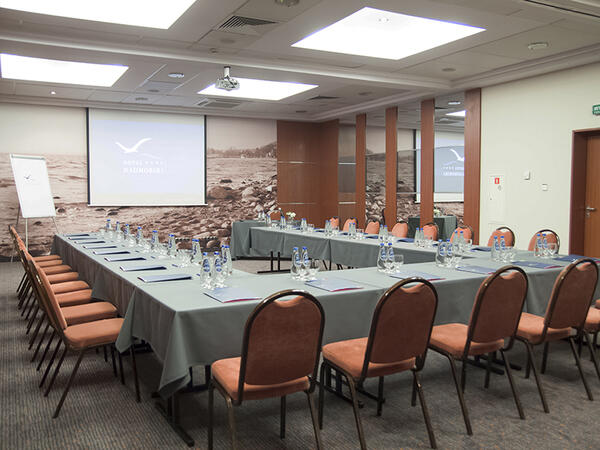
The training room is located just 3 kilometers from the PKP/PKS Station in Gdynia, making it easily accessible for participants traveling by train or bus. Additionally, it is only 400 meters away from the bus stop, facilitating access even for those using public transportation. It is equipped with necessary training tools such as a projector, screen, and flipchart, providing comfortable conditions for both participants and the trainer.
This instructor-led, live training in Gdynia (online or onsite) is aimed at advanced-level participants who wish to integrate Drools 8 with jBPM to design, execute, and optimize business workflows and processes.
By the end of this training, participants will be able to:
Set up Drools 8 and jBPM environments for development.
Define and manage complex business rules in Drools 8.
Design and execute workflows using jBPM.
Integrate Drools rules into jBPM processes for dynamic decision-making.
This instructor-led, live training in Gdynia (online or onsite) is aimed at beginner-level to intermediate-level business analysts who wish to use DSLs in Drools 8 to define, manage, and optimize business rules without relying heavily on technical programming skills.
By the end of this training, participants will be able to:
Understand the core concepts of Drools 8 and its architecture.
Create DSLs to simplify business rule definitions for non-technical users.
Manage, test, and maintain rules effectively using Drools Workbench.
Collaborate with technical teams to implement and refine business rules.
Apply best practices for rule optimization and lifecycle management.
This instructor-led, live training in Gdynia (online or onsite) is aimed at advanced-level participants who wish to optimize rule execution, integrate Drools with enterprise systems, and leverage advanced features like decision tables and domain-specific languages (DSLs).
By the end of this training, participants will be able to:
Optimize the performance of complex rule execution.
Utilize advanced Drools features such as decision tables, DSLs, and rule templates.
Integrate Drools seamlessly with enterprise applications and external systems.
Implement robust version control and collaboration mechanisms for rule development.
Design and deploy scalable Drools-based solutions for enterprise needs.
This instructor-led, live training in Gdynia (online or onsite) is aimed at intermediate-level participants who wish to build and manage complex business rules, optimize rule execution, and handle rule dependencies effectively using Drools 8.
By the end of this training, participants will be able to:
Create advanced business rules and manage their dependencies.
Implement decision-making logic using Drools rule groups and agendas.
Optimize the performance of rule execution in Drools.
Use advanced Drools Workbench features for rule management.
Integrate Drools with external data sources and systems.
This instructor-led, live training in Gdynia (online or onsite) is aimed at beginner-level participants who wish to learn the basics of Drools 8, set it up, and create simple business rules for better decision-making and automation.
By the end of this training, participants will be able to:
Understand the purpose and benefits of using Drools 8.
Set up the Drools environment and integrate it with applications.
Create, test, and deploy simple business rules.
Use Drools Workbench for rule management and decision tables.
Implement Drools in real-world scenarios to automate decisions.
This instructor-led, live training in Gdynia (online or onsite) is aimed at beginner-level participants who wish to learn essential concepts in probability, statistics, programming, and machine learning, and apply these to AI development.
By the end of this training, participants will be able to:
Understand basic concepts in probability and statistics, and apply them to real-world scenarios.
Write and understand procedural, functional, and object-oriented programming code.
Implement machine learning techniques such as classification, clustering, and neural networks.
Develop AI solutions using rules engines and expert systems for problem-solving.
Business Process Model and Notation (BPMN), Decision Model and Notation (DMN) and Case Management Model and Notation (CMMN) are three Object Management Group (OMG) standards for processes, decisions, and case modelling. This course provides an introduction to all of them and informs when should we use which.
This course is aimed at enterprise architects, business and system analysts and managers who want to apply business rules to their solution. With Drools, you can write your business rules using almost natural language, therefore reducing the gap between business and IT.
This instructor-led, live training in Gdynia (online or onsite) is aimed at intermediate-level developers who wish to get a solid introduction to Drools 6 and use it to implement business rules within their applications.
By the end of this training, participants will be able to:
Understand the core concepts and benefits of rule engines like Drools.
Use the Drools Workbench and Eclipse for rule authoring and testing.
Create, organize, and execute business rules with the Drools rule engine.
Apply advanced features like decision tables, ruleflows, and DSLs.
This 3 days course is aimed to introduce Drools 7 to Business Analysts responsible for writing tests and rules.
This course focuses on creating pure logic. Analysts after this course can writing tests and logic which then can be further integrated by developers with business applications.
This 3 days course is aimed to introduce Drools 6 to Business Analysts responsible for writing tests and rules.
This course focuses on creating pure logic. Analysts after this course can writing tests and logic which then can be further integrated by developers with business applications.
This course has been prepared for people who are involved in administering corporate knowledge assets (rules, process) like system administrators, system integrators, application server administrators, etc... We are using the newest stable community version of Drools to run this course, but older versions are also possible if agreed before booking.
This instructor-led, live training in Gdynia (online or onsite) is aimed at intermediate-level system administrators and developers who wish to configure, manage, and deploy Java applications on the JBoss platform.
By the end of this training, participants will be able to:
Install and configure JBoss Application Server and its core components.
Customize JBoss AS services for monitoring, database connections, and transaction management.
Develop and deploy EJB 3 session beans and web applications.
Utilize the JBoss Messaging Service to deploy and manage JMS applications.
Manage JBoss AS through the Java Management Extension and Administration Console.
Implement JBoss Drools for business rules management and utilize the Guvnor tool for rule development and testing.
This instructor-led, live training in Gdynia (online or onsite) is aimed at developers and business analysts who wish to build a management suite using jBPM.
By the end of this training, participants will be able to:
Follow business goals in detail, using flow charts.
Standarize a process to bridge the gap between design and the process implementation.
Standardize a business process model and notation.
Exchange BPMN definitions with other team members.
IBM ODM (a.k.a. WebSphere Operational Decision Manager) is a Business Rule Management System (BRMS). It consists of a central repository and automation engine that allow for the creation, management, testing and governance of business rules and events. Rules and events are stored in the central repository where they can be accessed and modified by individuals and software without the need to rebuild any software.
In this instructor-led, live training, participants will learn how to create, manage and execute business rules as well as how to deploy and manage an instance of IBM ODM Decision Management in a live environment.
By the end of this training, participants will be able to:
Manage ODM components, including IBM Decision Center and IBM Decision Server
Manage and execute business rules and events
Reduce the testing cycle by enabling other software applications to detect and pick up changes to rules
Combine decision making and change detection tools to facilitate adaptation, auditing, tracing and testing
Separate business rules from business applications for greater flexibility
Build easy-to-maintain business rule client applications
Use Event Designer to build business event projects
Deploy and test business event applications
Build a customized dashboard for monitoring business events
Enable collaboration among architects, developers and administrators for developing and maintaining decision services
Enable business analysts, policy managers and rule authors develop and maintain an application's decision logic
Audience
Developers
Project managers
Format of the course
Part lecture, part discussion, exercises and heavy hands-on practice
This course uses a practical approach to teaching OptaPlanner. It provides participants with the tools needed to perform the basic functions of this tool.
This course introduces the student to the Python language. Upon completion of this class, the student will be able to write non trivial Python programs dealing with a wide variety of subject matter domains. Topics include language components, working with a professional IDE, control flow constructs, strings, I/O, collections, classes, modules, and regular expressions. The course is supplemented with many hands-on labs, solutions, and code examples.
After Completing the course students will be able to demonstrate knowledge and understanding of Python Security Principles.
This training allows participants to gradually enter the world of programming in the Python language. The course covers the most important elements of the language—from basic syntax and working with the environment, through data operations and program flow control, up to functions, modules, and the first elements of object-oriented programming.
Participants will become familiar with key constructs used in daily programming work, learn algorithmic thinking, and organize code in a transparent and consistent manner according to best practices. During the training, significant emphasis is placed on writing high-quality code and error analysis.
Upon completion of the training, participants will be able to independently write simple scripts, create functions and classes, organize projects into files, as well as understand, analyze, and run Python code in practical applications.
The training focuses on building a Retrieval Augmented Generation (RAG) system, which combines the capabilities of large language models with information retrieval from local documents. Participants will learn how to create applications that answer questions based on their own data, eliminating the problem of hallucinations and knowledge limitations in LLMs.
The program guides participants through all key stages of creating a RAG system. They will become familiar with communication principles using the OpenAI API and the LangChain framework, which facilitates working with language models. Participants will learn how to process documents in various formats, divide them into optimal segments, and transform them into vector representations. They will also get to know the Qdrant database and mechanisms for semantic search based on embedding similarity.
We place special emphasis on the quality of system performance—participants will implement result reranking techniques and learn how to quantify retrieval effectiveness and generated responses using the DeepEval library. The program also covers practical aspects of prompt engineering and methods for avoiding typical pitfalls when working with LLMs.
The outcome of the training will be a functional web application built in Streamlit, which allows users to ask questions about their own document base. Upon completing the course, participants will be able to independently design and implement a RAG system tailored to their specific business needs.
In this instructor-led, live training in Gdynia (onsite or remote), participants will learn how to use Python skope-rules to automatically generate rules based on existing data sets.
By the end of this training, participants will be able to:
Use skope-rules to extract rules from available data.
Apply skope-rules to carry out classification, particularly useful in supervised anomaly detection, or imbalanced classification.
Generate rules for classifying new incoming data.
Fit rules to address real-world problems in fraud detection, predictive maintenance, intrusion detection, insurance application approvals, etc.
This training focuses on practical use of the Streamlit library to create interactive web applications and analytical dashboards in Python. Participants will learn to build functional user interfaces without needing knowledge of HTML, CSS, or JavaScript.
The program covers all key components of Streamlit – from basic text elements and layout to interactive input widgets, advanced features such as forms, charts, and file handling. Participants will understand session state management, result caching, and database integration, enabling them to create efficient production applications.
We emphasize practical application – each theoretical module is supplemented with exercises, and the training concludes with the creation of a complete project or two, depending on time availability.
Upon completing the training, participants will be able to design Streamlit applications independently – from simple dashboards to advanced analytical tools. They will gain skills for rapid prototyping of data science solutions and creating interfaces for machine learning models.
This course is aimed at enterprise architects, business and system analysts, technical managers and developers who want to apply business rules to their solutions.
This course contains a lot of simple hands-on exercises during which the participants will create working rules. Please refer to our other courses if you just need an overview of Drools.
This course is usually delivered on the newest stable version of Drools and jBPM, but in case of a bespoke course, can be tailored to a specific version.
Read more...
Last Updated:
Testimonials (10)
the Labs
Frank Mhlongo - Standard Bank of South Africa
Course - JBoss
The pace was good, with a nice mixture of knowledge sharing, demonstrations and practical work. Filip was very engaging and provided the energy to get through the course. It was good that there was a lot of 1:1 tuition, with Filip going through individual training exercises.
Colin - Worldpay
Course - BPMN, DMN, and CMMN - OMG standards for process improvement
Doing hands-on and/or use case activities.
Brian A - Thakral One, Inc.
Course - jBPM and Drools
Additional information about the problems and imperfections of the tool.
Slawomir Gubala - Tech-Com sp. z o.o.
Course - OptaPlanner in Practice
Machine Translated
a lot of practices are very welcome, many try and learn cases are embedded
Nadia Ivaniuk - Credit Suisse (Poland) Sp.z o.o.
Course - Modelling Decision and Rules with OMG DMN
practical part
Magdalena Orzedowska-Kubeczak - EduBroker Sp. z o.o.
Course - IBM ODM Decision Management
Machine Translated
Exercises and solving problems in groups when the problems were more difficult.
Randy Comer Comer - Sandia National Labs
Course - Drools 7 and DSL for Business Analysts
Examples, practical application, answers to questions
Rafal
Course - Wprowadzenie do Drools 7 dla programistów
Machine Translated
I really enjoyed the good atmosphere.
Martin Jesterschawek
Course - Business Rule Management (BRMS) with Drools
Lots of exercises, which were good and which were well-administered.
Online Business Rules training in Gdynia, Business Rules training courses in Gdynia, Weekend Business Rules courses in Gdynia, Evening Business Rules training in Gdynia, Business Rules instructor-led in Gdynia, Business Rules instructor-led in Gdynia, Weekend Business Rules training in Gdynia, Business Rules instructor in Gdynia, Evening Business Rules courses in Gdynia, Business Rules one on one training in Gdynia, Online Business Rules training in Gdynia, Business Rules private courses in Gdynia, Business Rules classes in Gdynia, Business Rules trainer in Gdynia, Business Rules on-site in Gdynia, Business Rules boot camp in Gdynia, Business Rules coaching in Gdynia